VDD is out: price software by what is verified, not by hours
Categories
Tags
Introduction
A few days ago we launched vdd-methodology.org, where I published Verification-Driven Delivery (VDD): an open methodology for estimating, pricing, verifying, and forecasting software delivery in the AI era. The Specification, the Implementation Playbook, spreadsheet templates, and a training presentation are free to download at vdd-methodology.org.
In my previous two articles, I described the problem: hourly billing, Story Points, and fixed bids all break once AI writes most of the code. I promised that a working answer was being built. This is that answer, and this article shows how it works on one real-size example.
This version 1.0 of the VDD methodology is like any first version: some parts may be imprecise or not yet described in enough detail, and I will start work on the next version soon, with a defined plan for additions. Comments, objections, and examples from your own delivery are welcome: they decide what changes next.
The billable hour is dead
AI compresses the time it takes to write code several times over. But the value was never in writing code faster. It is in independent verification and expert judgment, and those do not speed up when generation does.
The same feature has always taken different teams different hours. AI widens that gap and changes its nature: writing the code may now take a fraction of the time, while checking it takes as long as before. Hours measure less and less of what you actually get. If you pay by the hour, you pay for the slower path. If you pay by Story Points, you pay for a number nobody outside the team can check. Either way, the work that protects you, checking what was built, is the first thing cut when the budget gets tight.
A fixed price does not solve this either. A fixed bid is one number for the whole project, set before anyone knows the work. The vendor hides a risk premium inside it; every change becomes a negotiation, and when the budget runs short, verification is again the first thing cut.
VDD is not a fixed bid in a new wrapper. The price is fixed per Brick, not per project. Scope is counted story by story, every change is priced by the same rules before it is approved, and nothing is paid as delivered until it has been verified. The risk premium is not hidden in one big number: you see exactly what each part of the work costs.
The industry data says the same:
"Selling hours in the AI era is like selling candles in the age of electricity: technically possible, but why, except perhaps for décor and nostalgia."

Alexander Lipanov
Ph.D. Applied Mathematics,
CTO, SOFYCOD
Number
What it means
Source
90%
Software professionals use AI at work, up 14% in a year. Results depend on how organizations change their processes, not on adoption alone.
12.3%
The share of copy-pasted lines in changed code in 2024 was up from 8.3% in 2021, while refactored, reused code fell from 25% to under 10%. Based on 211 million changed lines.
+54%
More bugs per developer when an organization's AI adoption is higher than when it is lowest. Two years of telemetry from 22,000 developers in 4,000+ teams.
The usual answer is more process. What is missing is a unit: something you can count, price, and accept, built for what verification actually costs once generation is nearly free.
What VDD is
VDD replaces billed hours and relative story sizes with a countable unit of verified work. From one set of numbers, it answers four questions about any user story, feature, or product:
What will be built: a set of Delivery Bricks.
What it will cost: Bricks multiplied by a Price per Brick calibrated on your own delivery history.
When it will be delivered: a P50 and P85 range, recalculated from actual throughput.
How it will be accepted: through the Independent Verification Gate.
Five terms carry the whole method:
Term
Meaning
Delivery Brick
An atomic, objectively countable unit of engineering work: one endpoint, one UI component, one test case. Never a unit of time or AI compute.
Delivery Unit
One finished, independently verified user story: the sum of all the Bricks required to build and verify it.
Base Unit Rate
The price of one Brick in a category, calibrated on revenue from your own verified deliveries. Never an hourly rate.
Independent Verification Gate
The step in which someone who did not build a Unit checks and confirms it before it counts as delivered.
P50 / P85
Delivery dates met with 50% and 85% probability, computed from the team's actual throughput.
VDD does not replace your team's process. Keep Scrum, Kanban, or an agentic workflow: VDD changes the unit of price, acceptance, and forecast, not the ceremonies.
One user story, start to finish
The story "A customer can register on the portal" is one Delivery Unit of 23 Bricks, priced at $1,219. Here is how that number is built.
Three things in this table matter more than the total:
Every line is something you can point to in the finished product. Nothing is guessed, and two people counting by the same rules get the same number.
10 of the 23 Bricks are for verification. Plan and price verification from the start, not squeeze it in at the end.
Each category has its own rate. A Brick of AI or computer-vision work and a Brick of CRUD require different expertise and verification, so they aren't priced the same.
The rates here are illustrative and are drawn from the worked example in the Implementation Playbook. Each organization calibrates its own rates based on its delivery history.
When requirements change
With VDD, a change request is a number, not a negotiation. Only the changed part is recounted using the same rules and rates. This is called Re-Bricking.
Suppose the Customer asks to add Google sign-in to the registration story:
The P50 and P85 dates are recalculated with the four new Bricks. The Customer sees the new price and dates before approving the change, and nothing starts before approval. The record keeps the original count and every change, so you can audit any earlier state.
Nothing counts until it is verified
A Delivery Unit counts as delivered only after it passes the Independent Verification Gate: someone who did not build it checks it against its acceptance criteria and confirms it. This applies equally to code written by people and to code generated by AI. An author can't see their own blind spots, so the Gate is mandatory and never skipped for schedule reasons.
In practice, VDD allows two verification models:
Peer verification
Dedicated Verification Engineer
Who reviews the code?
Engineers on the team review each other's Units on a fixed schedule, for example, every Wednesday and Friday.
One engineer, who writes no feature code, reviews every Unit
Code-analysis tools
At the reviewer's discretion
Run on every Unit
Final acceptance
A QA engineer, against the test cases
A QA engineer or the Verification Engineer, if they changed nothing
Extra cost
None: no new role
One additional role
Fits best
Small teams, tight budgets
Larger teams, AI-heavy code, regulated domains
Cross-review is a familiar practice, close in spirit to pair programming. The dedicated Verification Engineer is not, and that difference matters more than it looks. Few teams have this as a dedicated role today, but as AI multiplies the volume of code, checking it can no longer be squeezed in between other tasks. A Verification Engineer independently checks someone's actual job, using code-analysis tools and the acceptance criteria, rather than as a line in a process document.
The need for the role can even be calculated. In the team from [the first issue of Production Proves](ссылка на первый выпуск), six engineers ship 62 features a month, with AI spending about 372 of their 1,000 hours on verification and 124 on code review. That's about one full-time Verification Engineer for every six engineers, plus QA for the test cases.
One rule holds in both models: no one performs the final acceptance of work they implemented or changed. Rework after a rejected check is recorded separately and feeds the measured verification effort of each category.
How VDD compares
The difference between hours and Story Points is not the size of the number but what it represents:
Hours
Story Points
Delivery Bricks (VDD)
What you pay for
Time spent
Relative effort
Counted, verified work
Known before work starts
No
No
Yes, per user story
Who checks the result
Usually the same team
The same team
Someone who didn't build it
Comparable across vendors
No
No
Yes
Forecast
Burn rate
Average velocity, one date
P50 and P85 from real throughput
Detailed comparisons with Story Points, Time & Materials, Function Points, and agentic delivery frameworks are at https://vdd-methodology.org/vdd-compare.
In delivery, VDD runs as a pipeline of four stages:
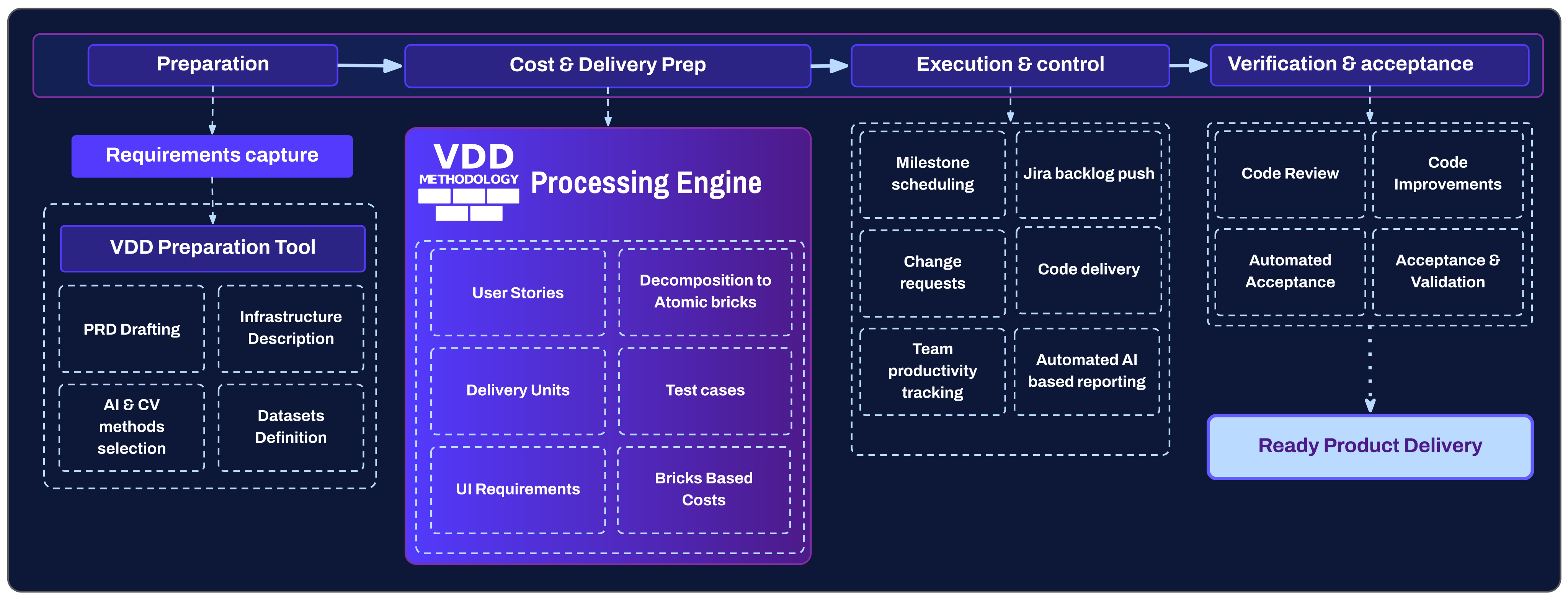
Preparation: requirements become a PRD and user stories with acceptance criteria.
Cost and delivery plan: every story is decomposed into Bricks, priced, scheduled, and given its test cases.
Execution and control: throughput is tracked every sprint, and every change goes through Re-Bricking.
Verification and acceptance: every story passes the Independent Verification Gate before it reaches the Customer.
What is published
Everything needed to apply VDD by hand is available now, free:
Document
What it gives you
Specification v1.0
The rules: definitions, the 12 Brick categories and their counting rules, the Verification Gate, the pricing and forecasting formulas, Re-Bricking
Implementation Playbook v1.0
The path from hours to VDD in seven stages: readiness check, retrospective decomposition, rate calibration, pilot, training, day-to-day rhythm
Spreadsheet templates
Brick Ledger, Rate Card, Throughput & Forecast and Environment Setup, with formulas ready, plus a filled worked example
Training presentation
The method explained for a team, slide by slide
The license is simple. VDD is free to use inside your organization for any business purpose, including pricing and delivering software for your own clients: no fees, no royalties, no registration. You can adapt Brick categories, rates, and templates to your own data. You need a written agreement only if you earn money from VDD itself, such as training, consulting, audits, or certification for others. The full terms are on the license page.
How to start
The first step takes an hour and costs nothing:
Download the documents at vdd-methodology.org/download.
Run the readiness check from the Playbook. It scores your data and your habits and tells you whether to start now, close one gap first, or wait.
Count one delivered story. Take a user story your team has already shipped, count its Bricks using the 12-category rules, and divide its cost by the count. That is your real price per Brick today.
If you buy software rather than build it, step 3 works too: ask your vendor to count a delivered story in Bricks, and compare their price per Brick with what you paid.
Would your organization be interested in enabling VDD Methodology in your development and delivery process? Do you want to pay for results instead of hours? Let’s discuss it!
Please contact me through the SOFYCOD corporate website, and I will be happy to consult with you and help with right pathway.